Beyond the Hire: Building a Platform for Capital Formation Success
INTRODUCTION
Alliance Search Partners, a portfolio company of Alliance Global Advisors, specializes in executive search for real assets investment managers, with a particular focus on capital formation leadership. Through our work, we consistently see a recurring challenge: firms often focus on finding the right person before evaluating whether the platform can support that person's success. This blog explores why organizational readiness often determines fundraising outcomes as much as talent itself and why platform readiness should be evaluated before making a capital formation hire.
Across the real assets market, the same pattern plays out again and again: a firm identifies a capital formation gap, hires a strong professional, waits for results and 18 months later finds itself disappointed. Sometimes the fit was wrong. Sometimes the market shifted, the strategy lost momentum, or the chemistry with leadership never fully formed.
More often, though, the issue is quieter and far more fixable. The hire was capable, and the firm was credible. What was missing was the infrastructure required to support the role: the structure, alignment and support that capital formation professionals need to succeed.
That is the pattern worth understanding because it is also the one firms can address before they ever go to market and make a hire.
What High-Performing Capital Formation Teams Do
The most effective capital formation teams share a set of recognizable behaviors rooted in a deep understanding of investors’ needs. They lead with market insight rather than a product pitch. They treat capital formation as a multi-year relationship-building effort, not a transactional process. They operate as strategic advisors inside their firms: trusted partners in firm strategy, not order-takers.
Let’s examine the nine key behaviors that high-performing capital formation teams share. Each one has an organizational infrastructure requirement behind it.
1. They Develop Relationships on the Investor’s Timeline
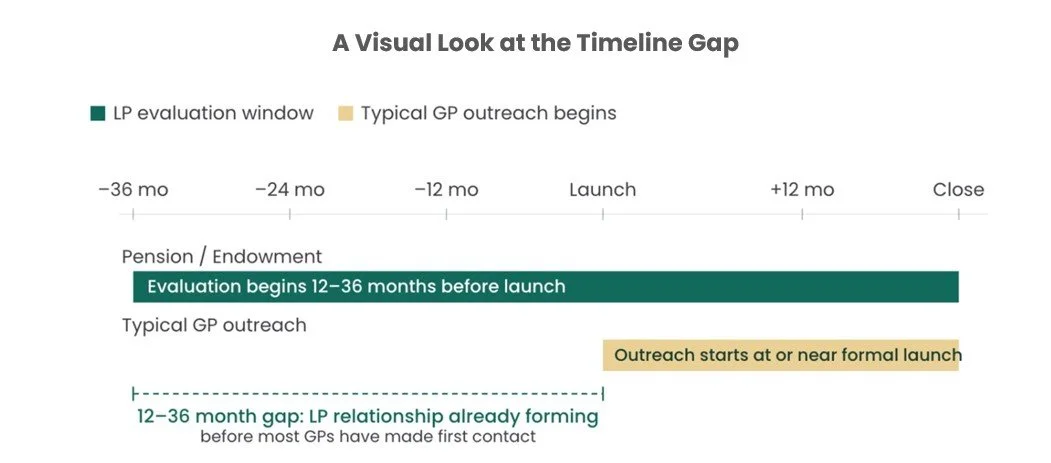
The fundraising calendar most investment managers operate on begins at or just before a launch. Most investors begin evaluating opportunities 12 to 36 months before a fund is formally marketed. Pensions, endowments and consultants form views, evaluating managers and making internal recommendations well before an investment manager enters the market. By the time a vehicle is announced, many investors have already formed opinions and established priorities.
High-performing capital formation teams understand this dynamic and plan accordingly. They are not racing to build relationships during a raise. They began building those relationships years earlier through consistent engagement and meaningful touchpoints long before capital was being sought.
The gap between when investors begin evaluating opportunities and when many investment managers begin engaging them is not a scheduling problem. It is a structural and hiring one.
The infrastructure solution: Firms that activate their capital formation function only when a new vehicle is being planned are entering a process that investors started without them. For optimal success, investment managers should consider hiring 12-36 months before a fundraise.
Source: Preqin Fundraising Report 2025
2. They Lead with Market Insight
Strong capital formation teams do not open with the track record or the ask. They open with market context: what they are observing in capital flows, where allocation gaps exist and what risks investors may be overlooking. This positions the capital formation professional as a thought partner rather than a product salesperson. In a crowded environment, that distinction often determines whether a second conversation happens.
They also take a disciplined approach to matching product offerings with investor needs and market positioning. Every conversation is built around fit, not pitch.
The infrastructure solution: investment and capital formation teams must share information in real time. When firms translate market perspectives into investor-ready messaging early in the process, capital formation teams can lead with relevant market observations rather than product promotion. Without that alignment, conversations risk becoming product-led rather than investor-led.
3. They Target with Precision
High-performing capital formation teams prioritize specific investors. They align strategy to known allocation gaps and exit conversations with mismatched capital early.
They protect their time and their investors’ time by being selective about whom they engage and when.
The infrastructure solution: a CRM (customer relationship management system) that tracks investor preferences, allocation history and relationship status with enough discipline that the team can make targeting decisions based on data.
4. They Treat Capital Formation as a Long Game
High-performing capital formation teams treat investor relationships as long term, not tied to any single vehicle. The hardest discipline is staying relevant during periods when the firm is not actively raising capital and there is no obvious reason to reach out.
They show up with value when no ask is on the table. They share market perspective, make useful introductions and help investors solve problems unrelated to their own fund. They also track how investor priorities, team structures and mandates evolve over time, ensuring each conversation reflects current realities rather than outdated assumptions.
When the next raise begins, they are not building relationships from scratch. They are continuing conversations that have been ongoing for years.
The infrastructure solution: leadership must view relationship maintenance as a business-critical function between raises, not a discretionary expense. Without that commitment, capital formation becomes reactive and every fundraising effort starts from a weaker position.
5. They Build a Trusting Relationship for the Investment Manager
Strong performance is often a given. Differentiation comes from how firms communicate that performance. High-performing capital formation teams build clear, repeatable narratives around complex strategies.
Investors allocate based on clarity and conviction, not data alone. Increasingly, investors are also underwriting operational trust alongside investment performance. The quality, responsiveness and institutional maturity of the capital formation function often influence how investors evaluate risk.
The infrastructure solution: organizational alignment is evident around investor communications, transparency and responsiveness. Investors evaluate the professionalism and institutional maturity of the platform. Trust is strengthened when the capital formation team is supported by consistent messaging, timely information and operational excellence across the firm.
6. They Operate as Internal Strategic Advisors
Effective capital formation teams sit at the intersection of investor sentiment, market reality and firm strategy. They align expectations with investment leadership, bring investor feedback into product design and positioning and help their organizations understand what investors value. The strongest teams ensure that feedback reaches decision-makers, even when it is difficult to hear.
This role depends on real access. A capital formation professional who understands how the firm makes investment decisions can communicate those decisions to investors with credibility. Access to the investment committee is not a privilege. It is a structural requirement.
The infrastructure solution: a leadership culture that values input from the capital formation function and incorporates it into decision-making. Firms that treat capital formation as a communications function rather than a strategic partner will struggle to retain professionals capable of playing this role.
7. They Are Disciplined About Follow-Through
High-performing teams follow up with precision: tailored materials, purposeful next steps and consistent advancement of each relationship. Every interaction moves a conversation forward or deepens a relationship. Nothing goes cold.
In a relationship-driven industry, execution consistency compounds over time. Investors notice responsiveness, coordination and organizational discipline, particularly during periods of market uncertainty or operational stress.
The infrastructure solution: operational support, a functional data room and a CRM workflow that makes follow-through a system rather than an individual discipline.
8. They Build Trust Through Selectivity
Effective capital formation teams curate their investor base and protect their relationships and positioning. Targeted selectivity signals quality and creates stronger alignment with investors.
The infrastructure solution: a compensation structure and organizational mandate that give the capital formation professional permission to walk away from misaligned capital. This behavior cannot be sustained by someone whose incentives reward volume over fit.
9. They Protect the Longevity of the Function
High-performing firms recognize that capital formation success depends on retaining strong professionals. When fundraising teams are consistently forced to compensate for unclear strategy, fragmented communication or operational gaps, burnout and turnover follow. The strongest platforms reduce internal friction so capital formation professionals can focus on investors rather than internal challenges.
The infrastructure solution: onboarding processes, leadership alignment and operational support that allow professionals to integrate quickly and operate effectively from the outset.
The Pattern Behind the Pattern
Look at those nine behaviors together and a clear structural reality emerges. Every one of them stems from organizational design, alignment, product-market fit and internal infrastructure. They are not personality traits. They are outputs of a platform built to support them.
That distinction matters because firms often attempt to solve structural issues through talent acquisition alone. In practice, the market usually detects those gaps faster than leadership expects.
The most successful firms recognize that talent amplifies readiness; it does not create it.
Hiring a senior capital formation professional to help build the platform can absolutely be the right decision. Many firms need a leader who can bring structure to fundraising efforts, help define strategy, establish processes, sharpen messaging and create accountability around investor engagement.
The challenge is that every hour spent building infrastructure is an hour not spent cultivating investor relationships.
When firms hire capital formation talent before the platform is ready, they are often asking one person to simultaneously build the engine and drive the car. It can be done, but it requires a different set of expectations around timing and outcomes.
This is where many managers encounter frustration. Eighteen months later, leadership looks around and asks why capital has not yet begun to flow at the pace they anticipated. In reality, much of that time is spent building the foundation for fundraising success: refining strategy and positioning, aligning internal stakeholders, implementing processes and strengthening investor engagement capabilities.
None of those activities is wasted effort. In many cases, they are essential. But they are fundamentally different from relationship development and capital raising.
The firms that achieve the strongest fundraising outcomes understand this distinction upfront. They either invest in readiness before bringing on senior capital formation talent or acknowledge that the initial mandate is as much about building organizational capability as it is about raising capital. When expectations are aligned, the hire is far more likely to succeed. When they are not, firms often mistake a platform challenge for a talent problem.
Q&A: What Firms Ask Us About SUCCESS IN Capital Formation
Q: Why do firms with strong capital formation hires still underperform?
In many cases, the issue is not the hire. We typically see two underlying causes. First, the fundraising timeline is often built around the investment manager’s schedule rather than the investor’s decision-making process. By the time a firm begins raising capital, many investors have already formed views and established priorities.
Second, the organization is often not structured to support the role. Unclear ownership, misaligned expectations, inconsistent messaging and limited internal support can all reduce a professional's effectiveness, regardless of experience.
By the time fundraising results reveal the problem, firms have often lost valuable time and, in some cases, the professional they hired.
Q: What does a capital formation platform require from organizational design?
More than most firms realize. We focus on four areas: clear ownership, appropriate compensation, a compelling investor narrative and firmwide alignment around capital formation as a strategic priority. Weakness in any one of these areas can limit fundraising effectiveness and make it difficult for even strong professionals to succeed.
Identifying these gaps before a search begins is often just as important as identifying the right candidate.
Q: How do we know if our platform is ready to support a senior capital formation hire?
Most firms cannot answer that on their own, which is the point. Platform readiness is rarely determined by the obvious factors. We evaluate areas such as ownership of investor relationships, the strength of the firm's investor narrative, due diligence preparedness, organizational alignment and the support structure surrounding the role.
Before beginning a search, we conduct a structured assessment designed to identify the factors that most often influence whether a capital formation hire succeeds. Some firms are ready to go to market immediately. Others discover a handful of gaps that can be addressed before making a hire.
In our experience, firms that invest in readiness upfront tend to hire more effectively, onboard more smoothly and create an environment where capital formation professionals can succeed over the long term.
What We Do Differently at Alliance Search Partners
When you engage Alliance Search Partners, you are not hiring a vendor to run a process. You are bringing in a partner to assess your platform, identify potential gaps and help you attract the talent best positioned to drive results.
We bring deep market intelligence and extensive industry access, informed by Alliance Global Advisors' decades of trusted relationships across the investor, investment manager and consultant communities.
We evaluate your organization the way an investor eventually will, and the way top candidates already do. When a platform is not ready, the professionals who have moved the needle can sense it and often pass. Firms rarely realize they are screening themselves out of the top tier and settling for candidates who interview well but have not performed at the level required.
Whether you are preparing for a fundraise, considering your first institutional capital formation hire or evaluating your platform's readiness for growth, we can help.
Contact Stacy Schiffman to discuss your platform, fundraising strategy or capital formation hiring needs: schiffman@alliance-globaladvisors.com
ABOUT ALLIANCE GLOBAL ADVISORS
Founded in 2020, Alliance Global Advisors is a women-owned consulting firm focused on developing strategic growth solutions for real asset investment managers. Advising clients with over $1.5 trillion in assets under management, Alliance partners with organizations to provide an informed, independent perspective, continued education and innovative guidance on structuring investment products to attract evolving sources of capital in a competitive environment. Through this work, Alliance helps senior management teams strengthen decision-making, enhance institutional readiness and position their platforms for long-term value creation and performance.
Disclaimer:
This blog was originally published in June 2026 and will be updated periodically to reflect changes in the industry. The content may contain or cite personal and/or professional opinions that differ from the views of Alliance Global Advisors.