
Deployment With Direction: How Managers Implementing AI Can Bridge the Governance Gap
Introduction
In early 2026, Alliance Global Advisors (“Alliance”) surveyed investment managers across its client and advisory network about artificial intelligence (AI), including how firms were using it, what they were spending and whether their organizations were equipped to support it responsibly. What they shared confirmed what Alliance had been observing in conversations with managers for the better part of two years: firms are scaling AI faster than they are building the governance, training and accountability structures required to sustain it.
That finding is what formalized Alliance’s Data & Technology Advisory practice. Alliance had already been doing this work, helping managers evaluate tools, build policies and close operational gaps across client engagements. The survey gave us the language to name it and the data to explain why it matters now. The respondents represent investment managers ranging from sub-$1 billion platforms to firms managing more than $10 billion. The results are not a market-wide census. They are a candid look at what a cross-section of active, institutionally oriented managers told Alliance when asked directly, and the patterns are consistent enough to be instructive for any firm evaluating where it stands.
Alliance's perspective: The managers pulling ahead are not those with the largest AI budgets, but those treating AI as an operating discipline. Market leaders are pairing deployment with governance, training and clear human-in-the-loop accountability.

Where Managers Stand
AI maturity across real assets managers remains uneven, but adaptation momentum is clearly accelerating. Most respondents are actively moving from experimentation to scaled deployment over the next year. Notably, only one firm described AI as fully embedded today, while a smaller subset remains in exploratory or pilot phases, highlighting meaningful dispersion along the adoption curve.
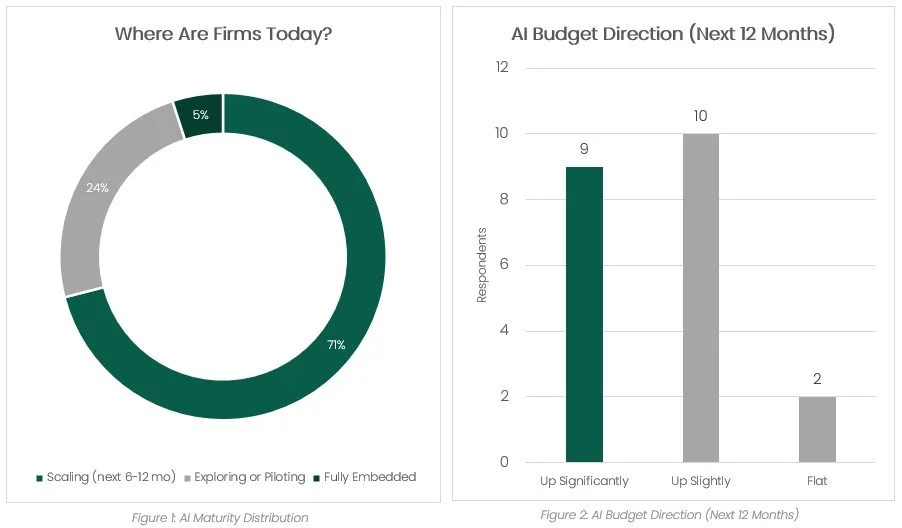
Budget expectations reinforce this momentum. Nearly every firm anticipates increased AI spending over the next 12 months, with a material share projecting significant growth. Importantly, no respondent indicated plans to pull back investment, signaling that AI is now viewed as a structural priority rather than a discretionary experiment.
Alliance’s perspective: There is a near-term window of adoption. Some firms risk being left behind if they don’t dedicate significant time and attention to their corporate AI plans.
What’s Working and What Isn’t
Productivity is the common entry point. Every respondent cited it as either a realized or targeted benefit, reflecting early wins through faster workflows and improved output quality. Research and market analysis have emerged as the most widely deployed use case to date, underscoring AI’s immediate value in information-intensive functions.
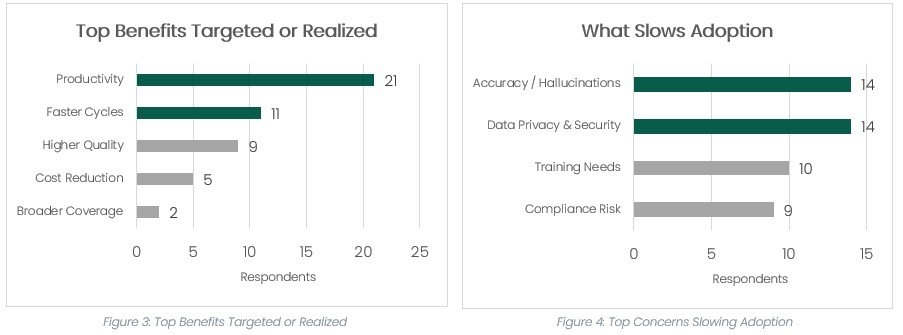
Yet adoption is far from frictionless. Concerns around accuracy and hallucinations, as well as data privacy and security, were each cited by roughly two-thirds of respondents. Training gaps and compliance risk followed closely behind. Together, these pressures point to a recurring theme: tools are being deployed faster than firms are building the policies, controls and shared understanding required to support them.
One data point is particularly telling: fewer than half of respondents have conducted firmwide AI training, despite most describing AI as broadly used across teams. The clearest pattern in the data is not resistance to AI, but a widening gap between deployment and structured enablement.
Alliance’s perspective: Governance and staff training are often overlooked but are critical pieces to a successful AI implementation plan.
The Talent and Staffing Shift
AI adoption is beginning to influence how firms think about talent, not just efficiency. More than a quarter of respondents expect AI to reduce headcount over the next three years, while hiring priorities are shifting toward skills that complement, rather than replicate, automation.
AI and broader technology fluency now rank as the most in-demand capability for new hires, alongside critical thinking and judgment. This signals a reframing of the human role: firms are increasingly looking for professionals who can direct, interrogate and govern AI outputs, not simply use the tools.
Ultimately, this is not a race to deploy AI for its own sake. The firms most likely to gain durable advantage will be those that pair rapid adoption with disciplined governance, thoughtful training and a clear operating model for human-in-the-loop decision-making. AI is already reshaping institutional real estate, but execution, not access, will determine who leads.
Questions Investment Managers Are Asking About AI
How are investment managers using AI in real estate?
Research and market analysis lead today, with managers using AI to accelerate information-intensive workflows such as synthesizing market data, summarizing documents and drafting first-pass analysis. Productivity gains in these functions were cited by every respondent as either realized or targeted.
What are the risks associated with AI for investment managers?
Accuracy and hallucination risk, data privacy and security concerns, training gaps and compliance risk. Roughly two-thirds of respondents flagged accuracy and data security specifically. The common thread: tools are outpacing the policies, controls and shared understanding firms need to support them.
How are real estate firms training employees on AI?
Not consistently. Fewer than half of respondents have conducted firmwide AI training, even though most describe AI as broadly used across teams. This deployment-versus-enablement gap is the clearest pattern in the data.
Will AI replace jobs in real estate investment management?
More than a quarter of respondents expect AI to reduce headcount over the next three years. At the same time, AI and broader technology fluency now rank as the most in-demand capability for new hires, alongside critical thinking and judgment, signaling a reframing of the human role toward directing, interrogating and governing AI outputs.
CONNECT TO LEARN MORE
Alliance's Data & Technology Advisory practice was established to help investment managers close the deployment-versus-enablement gap highlighted throughout this survey. From technology governance and policy development to operational readiness, performance measurement and strategic growth initiatives, Alliance helps managers translate technology ambitions into institutional-grade execution.
Alliance's work spans investment, operations, investor relations and leadership functions, providing a unique perspective on how firms are approaching AI adoption, governance and organizational readiness. This cross-functional view allows us to help clients benchmark their strategies against industry peers and identify opportunities for improvement.
To participate in the survey, receive the full results or discuss your firm's AI strategy and Data & Technology needs, contact Alliance at connect@allianceglobaladvisors.com.
ABOUT ALLIANCE GLOBAL ADVISORS
Founded in 2020, Alliance Global Advisors is a women-owned consulting firm focused on developing strategic growth solutions for real asset investment managers. Advising clients with over $1.5 trillion in assets under management, Alliance partners with organizations to provide an informed, independent perspective, continued education and innovative guidance on structuring investment products to attract evolving sources of capital in a competitive environment. Through this work, Alliance helps senior management teams strengthen decision-making, enhance institutional readiness and position their platforms for long-term value creation and performance.
Disclaimer: This blog was originally published in June 2026 and will be updated periodically to reflect changes in the industry. The content may contain or cite personal and/or professional opinions that differ from the views of Alliance Global Advisors.